What it does
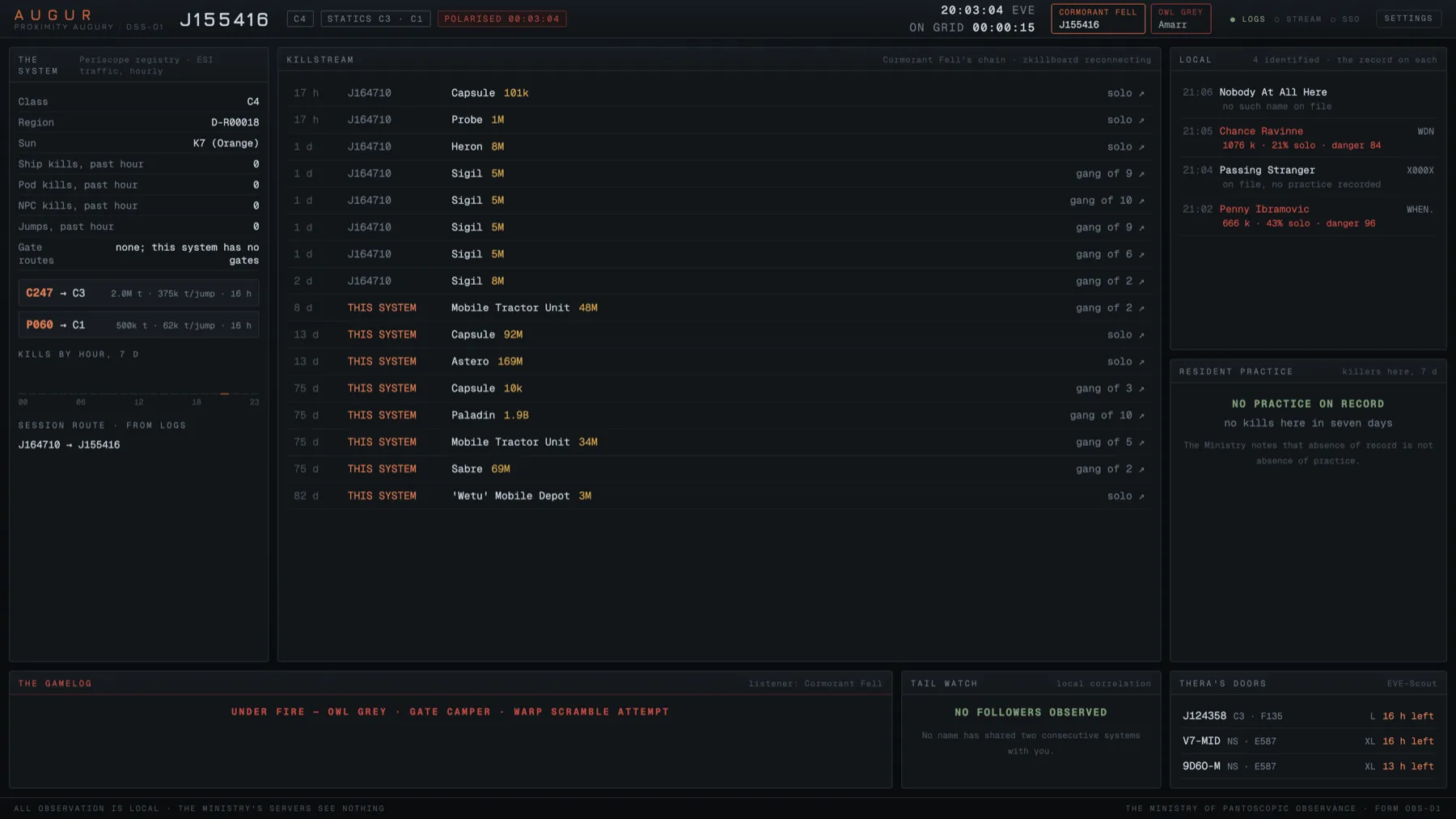
It knows where you are without being told. The client writes a chat log and a game log for every character flying. AUGUR reads them. That is the whole of its access: no login, no key, no account, nothing held. Change system and the desk changes with you, in about half a second.
It reads Local as a register of names, not a conversation. Anyone who speaks has identified themselves, so the desk answers with the record on them — affiliation, kills, the share done alone, and the killboard's own danger figure. What they actually said is their business and is not displayed.
It follows every character at once. Fly two, fly four; each is watched, and an alarm on any of them is an alarm, whoever the desk is currently displaying. Being shot at raises a banner, a tone and a notification, and names the character it happened to. The desk itself does not move without being asked.
It times polarisation before the hole refuses you. A gate transit writes a line in the ship's log; a wormhole transit writes nothing at all. A change of system with no gate line beside it is therefore a wormhole crossing, and the five minutes are a subtraction. The desk shows the exits that would turn you away, counting down, while you can still choose a different one.
It keeps the rest of the desk fed. Kills in your chain as they are filed, the system's own class, effect and statics, who has actually killed here in the last seven days and at what hours, the nearest Thera and Turnur exits with real jump counts, and a tail watch that notices when a name has followed you through two consecutive systems.
Two habits worth knowing
The consult. Copy a d-scan or a probe window in the client and AUGUR reads the clipboard and responds — no paste box, no mode to choose, the content declares what it is. It is off until you switch it on, and the watching is entirely local.
The public counter. AUGUR can hand the same reading to a browser on the same machine, or on the local network if you explicitly permit it. Useful for a phone beside the keyboard. It holds no session and accepts no writes, so a page reading it can see everything the window sees and change nothing. The Ministry notes that permitting the network also permits the network.
Collect it
AUGUR is built, installed and in daily use, and is not yet issued to the public. The source is unpublished and there is nothing here to download. When the window opens, the installers for macOS, Windows and Linux will appear at this address and the stamp above will change.
Its ancestor, HARUSPEX, does much the same office in a terminal and is issued today.